Every metal we work with has a personality — a conductivity, a corrosion profile, a thermal ceiling, a lifecycle cost. The most important decisions in our factory are not about design; they are about matching the right alloy and gauge to the cooking task it will face for the next twenty years.
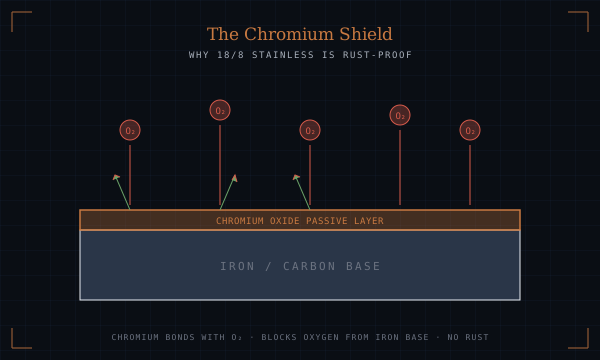
Not all stainless steel is equal. The two most important grades for kitchenware are 18/8 (also called SS304, or 18/10 at slightly higher nickel) and 18/0. The 8% nickel in 18/8 makes it highly anticorrosive and high-lustre — the premium choice for food-contact surfaces. 18/0 drops the nickel entirely, making it cheaper, more magnetic (induction-compatible), and acceptable for budget flatware and teapot applications. For cookware food-contact, always insist on 18/8 / SS304 minimum.
| Composition | 18% Cr / 8% Ni |
| Corrosion | Highly anticorrosive |
| Luster | High luster mirror-grade |
| Use | Cookware, heavy hollowware |
| Cost | Premium investment |
| Composition | 18% Cr / 0% Ni |
| Corrosion | Lower resistance |
| Luster | Matte / minimal |
| Use | Flatware, small teapots |
| Cost | Budget / high-turnover |
Processed at 18–22°C. Thinner cell walls, higher porosity, good for decorative colour applications but weak against abrasion.
Processed near freezing (-2 to 4°C). Rapid oxide growth meets minimal dissolution, creating dense hexagonal cell structure. 60–70 HRC hardness — exceeds hardened steel.
We offer both processes. For mass-catering aluminium vessels destined for labour camps and wedding halls where the pots see daily wood-fire abuse, we specify Type III hardcoat at the buyer's option. For retail cookware where cosmetic colour matters more than abrasion resistance, Type II is sufficient and more economical.
| Dimension | PTFE (Teflon-type) | Ceramic (Sol-Gel) |
|---|---|---|
| Chemistry | Carbon and fluorine atoms (PFAS family) | Silicon dioxide (sand-based) |
| Toxicity | Emits toxic fumes if overheated | 100% PFAS-free |
| Thermal Ceiling | Degrades rapidly above 260°C (500°F) | Safe up to 425°C (800°F) |
| Culinary Edge | Unbeatable slickness for delicate eggs/fish | High-heat searing without chemical anxiety |
| Lifespan | Degrades via thermal shock and metal utensil contact — "disposable by design" | Longer thermal tolerance but still finite |
Despite manufacturer promises, all non-stick pans are disposable by design. They degrade via thermal shock, metal utensil contact, and aerosol cooking sprays. True multi-generational durability exists only in uncoated substrates — tri-ply stainless steel and heavy cast aluminium. This is why our flagship products are uncoated: when you buy a Jitendra Udyog vessel, you should still be using it in 2046.
Searing, tomato sauces, citrus reductions
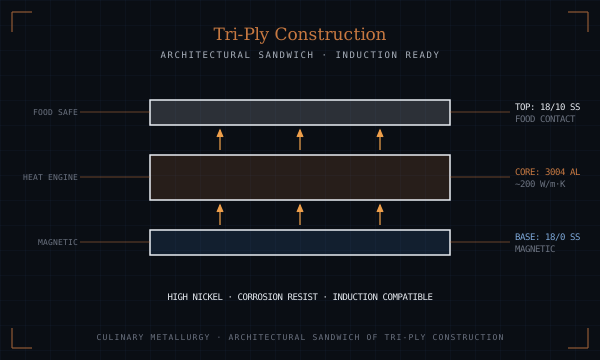
Recommendation: Tri-Ply Stainless Steel. 3004 aluminium core drives heat distribution; 18/10 stainless contact layer resists acid attack. The lifetime workhorse.
Biryani, stew, mandi, bulk curries
Recommendation: Heavy Cast/Spun Aluminium. Unmatched thermal mass prevents scorching at scale. 6–12 mm wall gauge survives open-flame use for decades.
Eggs, fish, pancakes, sauces
Recommendation: Ceramic or PTFE non-stick over aluminium. Treat as a short-term, eventually disposable tool — replace every 2–4 years.
Whole lamb, slow stew, dum biryani
Recommendation: Cast Aluminium or Copper-Lined. Unmatched heat retention and domed-lid moisture cycling.
Broth, noodle soup, salt-brined cooking
Recommendation: SS316 Marine Grade. Molybdenum addition resists pitting from chloride ions. +30% cost over SS304, worth every rupee for Far East coastal buyers.
Khoya, rabri, milk reduction, halwa
Recommendation: SS304 Heavy Sandwich Base. Prevents scorching; non-reactive with dairy; easy cleaning for food-safety audits.
Tell us the cooking task, expected volume, and operational environment (open flame, gas, induction, electric). Our technical desk will recommend the right alloy, gauge and finish — with a working specification and indicative FOB quote.
Request Technical Consultation