Market Intelligence

The $34 billion opportunity our buyers are already inside.

We publish the same market intelligence our own export desk uses — because informed buyers make better partners. Below is the real data shaping demand, pricing, competitor positioning, and freight economics in the global catering equipment sector through 2033.

Macro Market Scale

The B2B catering equipment boom is structural — not cyclical.

Three independent market segments are growing faster than global GDP, all driven by demand forces that are not going to reverse: Vision 2030 mega-projects in Saudi, outsourced corporate catering across the UAE, cloud-kitchen expansion worldwide, and Hajj infrastructure upgrades. The buyers who lock in supply contracts now — against current LME-indexed pricing — will protect themselves from 2030 scarcity pricing.

Global Catering Equipment $23.13B → $34.18B by 2033 (5.1% CAGR) Driver: massive expansion of cloud kitchens, quick-service restaurants, and automated food delivery services worldwide.
Middle East Food-Service Equipment $2.61B → $4.55B by 2033 (6.8% CAGR) Driver: Saudi Arabia dominates with 32.2% market share, fuelled by Vision 2030 hospitality giga-projects like NEOM and the Red Sea Project.
UAE B2B Catering Services $4.01B → $6.89B by 2034 (6.2% CAGR) Context: 71% of organised institutional food service is outsourced. Corporates, industrial facilities (labour camps) and hospitality account for over 62% of regional demand.
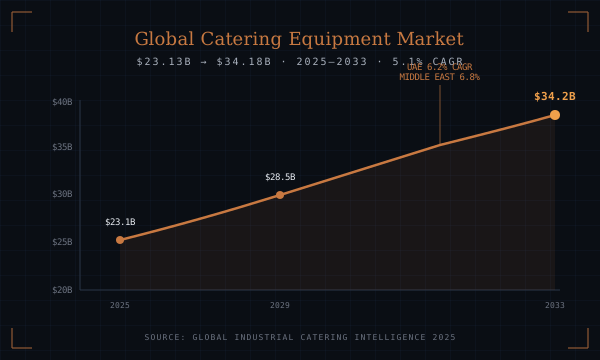
Market growth curve 2025-2033
Stainless Steel Global Growth and Safety Guide 2024-2026

SOURCE: INDUSTRIAL PIPELINE BLUEPRINT · STAINLESS STEEL GLOBAL GROWTH & SAFETY GUIDE 2024–2026

Regional Demand Mapping

Cultural and commercial divides that drive SKU selection.

The three primary export regions do not buy the same product. A 60″ aluminium deg sells into Saudi labour camps but is functionally useless in a European hotel kitchen. A tri-ply SS304 stockpot commands a 20% premium in Germany but is over-engineered for a Hajj field kitchen. Matching the SKU to the region is the first discipline of successful export.

Regional demand breakdown chart
Middle East

Volume & Scale

$2.61B → $4.55B · 6.8% CAGR

Target segments: labour camps, Hajj catering, wedding halls.

Market behaviour: Price-sensitive bulk buying. Margins rely on 40HQ container volume and nesting oversized vessels to slash freight costs.

  • High demand: Giant aluminium degs (40–80″), siniyah trays
  • Niche: SS304 stockpots, cast brass urulis
  • Avoid: Induction bases (not yet common)
Europe

Compliance & Finish

LFGB Certified · 15-20% premium

Target segments: HoReCa, institutional (schools, hospitals), bakeries.

Market behaviour: Premium pricing. 15–20% markup paid for LFGB certifications, flawless TIG welding, and brushed satin finishes.

  • High demand: SS304 tall stockpots, gastronorm pans, unlined copper confectionery basins
  • Niche: Traditional handis, rough-finish aluminium
  • Mandatory: LFGB, EN 631, induction-ready
Far East

Corrosion Resistance

SS316 · +30% premium

Target segments: street food, massive hotel chains, industrial kitchens.

Market behaviour: Balanced market requiring extreme durability against high-salt and acidic boiling conditions.

  • High demand: SS316 broth/noodle pots, giant carbon steel/aluminium woks
  • Niche: Flat siniyah trays, oversized degs
  • Mandatory: Chloride resistance, mixed-SKU shipments
Competitor Positioning

The disruption playbook — global benchmarking.

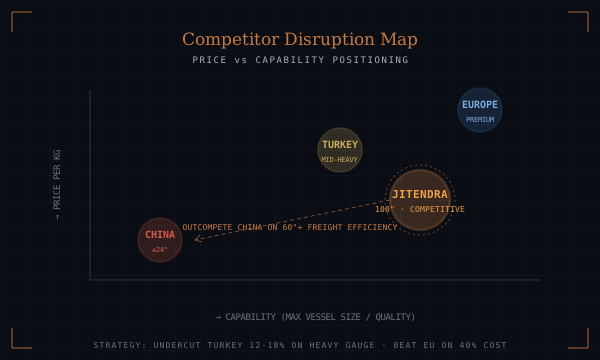
We compete against three very different origin profiles, each with a specific strength and a specific fatal weakness. Understanding these positions lets us target the exact niches where our structural advantages (multi-metal Jagadhri ecosystem + fabrication above 60″ + India's low-cost SS producer status) translate into winning contracts.

Competitor positioning matrix
OriginPrimary MaterialStrengthsFatal WeaknessesOur Target Strategy
China
(Guangdong)
SS201, thin SS304, thin aluminium Rock-bottom pricing on lightweight, automated items up to 24″ Cannot efficiently ship massive vessels (60″+) — shipping air destroys freight economics. Poor heavy-duty welding capability. Beat via nested sets for massive vessels. Our 30/40/50/60″ nesting annihilates their freight efficiency above 24″.
Turkey
(Kahramanmaraş)
High-grade aluminium, copper, SS Beautiful finishes, excellent Middle East brand reputation, strong casting capabilities High labour and energy costs driving up FOB prices significantly. Less flexible on custom heavy-gauge orders. Undercut Turkish prices by 12–18% on heavy-gauge 8mm+ aluminium degs. Match their finish quality at lower FOB.
Europe
(Italy / Spain)
Tri-ply, premium SS304/316 Brand prestige, perfect LFGB/EN compliance, full induction-ready range Exorbitantly expensive domestic manufacturing. Cannot scale labour-intensive production profitably. Offer exact SS304 gauge replications at ~40% of their local manufacturing cost, with matching LFGB certification.
The Oversized Freight Gap

Why China cannot compete above 60″ — our structural advantage.

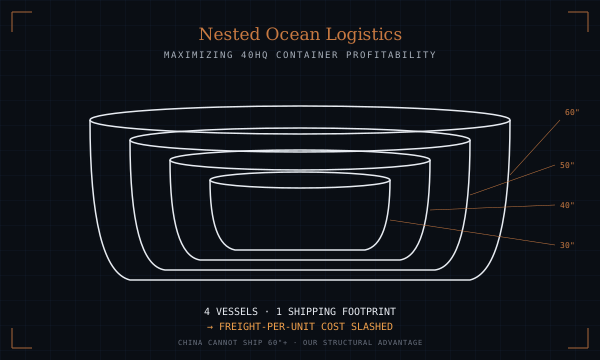
Chinese competitors avoid 60″+ vessels for a simple economic reason: shipping volume far outweighs cargo value. A single 80″ deg fills a container with empty air, and the freight-per-unit cost destroys export margins. This is why Chinese cookware exports fall off a cliff above 24″ diameter.

Our answer is structural nesting. We design our 30″, 40″, 50″ and 60″ catering degs so they stack concentrically inside a single outer vessel. Four vessels ship in one footprint. On a 40HQ high-cube container bound for Jebel Ali or Jeddah, nested loading slashes freight-per-unit cost dramatically — and unlocks access to the mass-catering segment where Chinese competitors cannot participate.

This is a structural advantage, not a price war. Chinese factories cannot replicate nesting without first investing in hand-fabrication capability they have deliberately avoided. Our freight advantage compounds with every container we ship.

Nested ocean freight diagram
Raw Material Pricing Engine

Every quote indexed to the London Metal Exchange.

We never quote per piece. Our pricing engine is built from three transparent inputs: the base LME ingot cost for aluminium, stainless steel or copper; our processing and welding fee per kilogram; and the total finished vessel weight. The final FOB export price is a straightforward function of these three numbers. Buyers can verify it at any time against live LME data.

Pricing Formula

Base LME Ingot Cost + Processing Fee per Kg × Total Vessel Weight = FOB Export Price

This formula protects both sides. When LME aluminium rises (as it has through 2025-2026 due to Guinea bauxite disruptions and Gulf smelter suspensions), our quotes rise transparently with the index. When the market softens, our quotes soften with it. No hidden margins; no surprises at invoice time.

MaterialBase CostProcessingFOB FinishedStrategic Note
Aluminium (1000/3000 series) ₹220–240/kg ₹140–160/kg ₹380–420/kg Highly profitable for massive oversized vessels. Core metal for Middle East catering SKUs.
Stainless Steel (SS304) ₹280–320/kg ₹200–250/kg ₹500–580/kg Mandatory for EU exports (+40% cost over SS202 but zero compromise on LFGB compliance).
Stainless Steel (SS316) ₹400–450/kg ₹250–300/kg ₹720/kg Required for Far East acidic/salt broths (+30% premium). Marine-grade corrosion resistance.
Copper ₹850–900/kg Hand-hammer ~₹1300/kg Luxury HoReCa and European heritage retail. Subject to extreme LME volatility — lock in pricing on PO date.
Brass ₹600–650/kg Hand-hammer ~₹950/kg Ceremonial and traditional retail. Stable pricing relative to copper.

Market outlook: LME aluminium prices are projected to remain elevated through 2026 due to geopolitical disruptions (Guinea bauxite, Australian alumina) combined with sustained EV and green-tech demand acting as a safety net against price falls. Strategic takeaway: buyers should lock in long-term contracts based on heavy-gauge metal weight to hedge against volatility.

The 2026 Playbook

Three non-negotiables for serious export buyers.

Imperative 01

Engineer for Purity & Durability

The 2026 market demands 18/8 stainless and LFGB-grade production. Do not compromise on molecular integrity. The premium you pay upfront returns ten-fold over the 20-year service life of a professional cooking vessel.

Imperative 02

Harden the Supply Chain

Anticipate extreme mechanical and climatic stress. Containerise and package for worst-case sea-freight scenarios: saltwater exposure, temperature fluctuation, corrosive humidity, and severe mechanical stress in transit.

Imperative 03

Filter for Intent, Not Volume

Abandon B2C vanity metrics. Restructure procurement against hyper-specific B2B criteria: MTRs on demand, passivation certificates, batch traceability, and supplier declarations that align with FDA and LFGB requirements.

Want the full intelligence briefing?

Verified buyers can request our complete Global Industrial Catering Intelligence report — including regional SKU targeting, freight cost modelling, and the supplier compliance checklist.

Request Intelligence Briefing