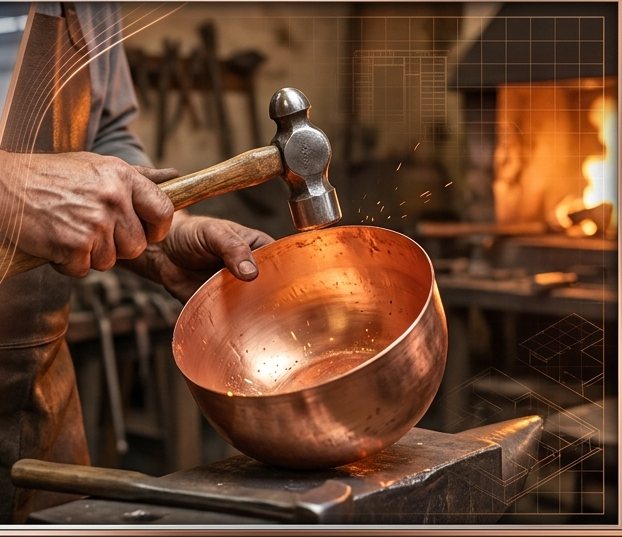
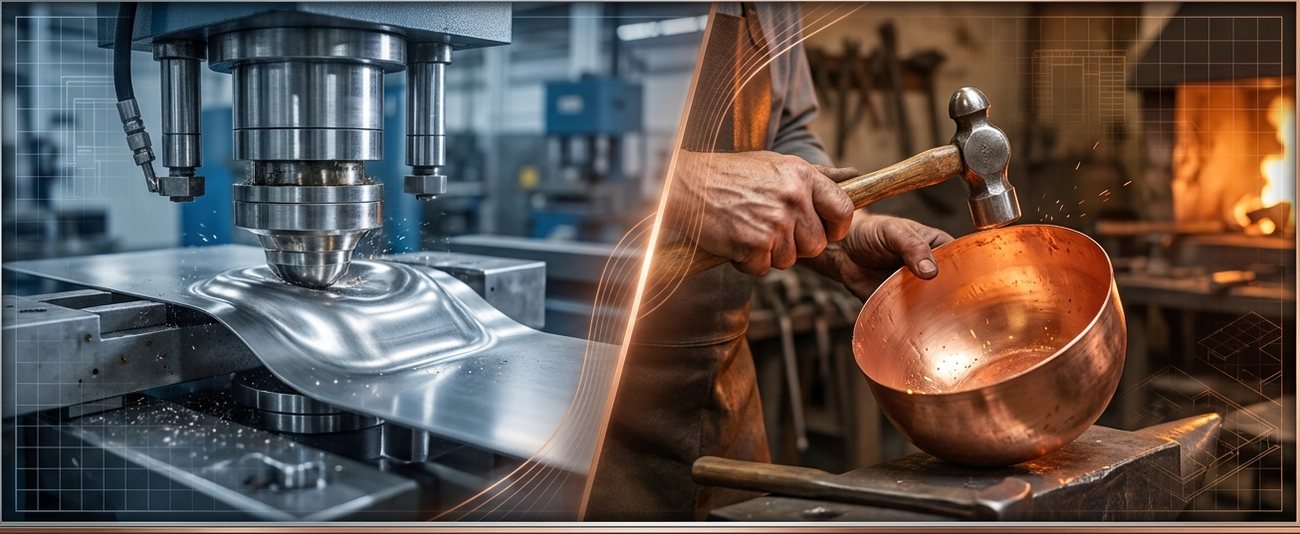
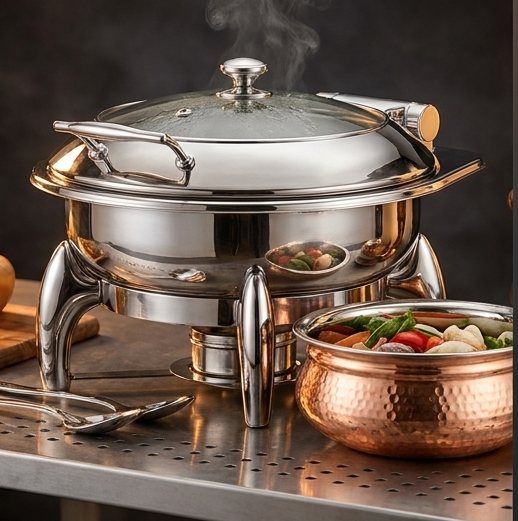
Four decades of spinning, drawing, hammering and tin lining held in-house as core skills. What we make ourselves and what we source through the Jagadhri cluster is stated plainly on every quotation.
A mixed container needs both. Very few works can offer them together — which is precisely why buyers who want machine consistency and hand-raised copper in one shipment end up here.
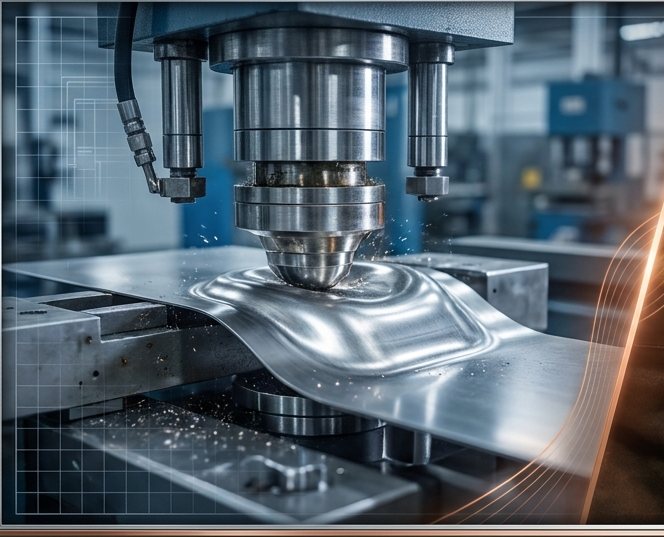
Every operation below happens here or within the Jagadhri cluster. Each pair shows the operation on the left and, on the right, the goods that operation actually produces.
Nothing moves forward until the previous stage is signed off. SGS, Intertek or your own team welcome at any point.
No single factory in India owns every process. What Jagadhri gives is density — rolling, plating and finishing units within kilometres, and the hand skills that cannot be bought in.
This is the table we quote from. Grade is stated on the invoice, with mill test certificates traceable to the melt.
| Grade | Composition | Magnetic | Corrosion resistance | Ideal application |
|---|
SS 202 is perfectly good for a dry-use thali. It is not the right material for a chafing dish sitting in a wet well for eight hours. Any supplier who tells you 202 and 304 are interchangeable is selling you the cheaper one. We will always tell you exactly which grade a quotation is built on.
Full-wall clad, encapsulated sandwich, or hard-anodised. The right choice depends on whether the buyer needs induction, price, or both.
Finish is not decoration. A brushed satin hides fingerprints in a hotel; a mirror polish sells on a retail shelf. We finish to the market, not to a default.
Northern India is further from a port than the coastal clusters, and that adds days to transit. What the north gives back is the cluster itself — an unmatched multi-category catalogue, deep hand-skill, and iteration speed on samples. For a single commodity in volume, go coastal. For a mixed, crafted container, come to us.
Two documents. The first is every product family with materials, sizes and applications. The second is the works — process, grades, construction and logistics.
Mill test certificates traceable to melt, retained pre-production samples, and full retail-ready packaging.